
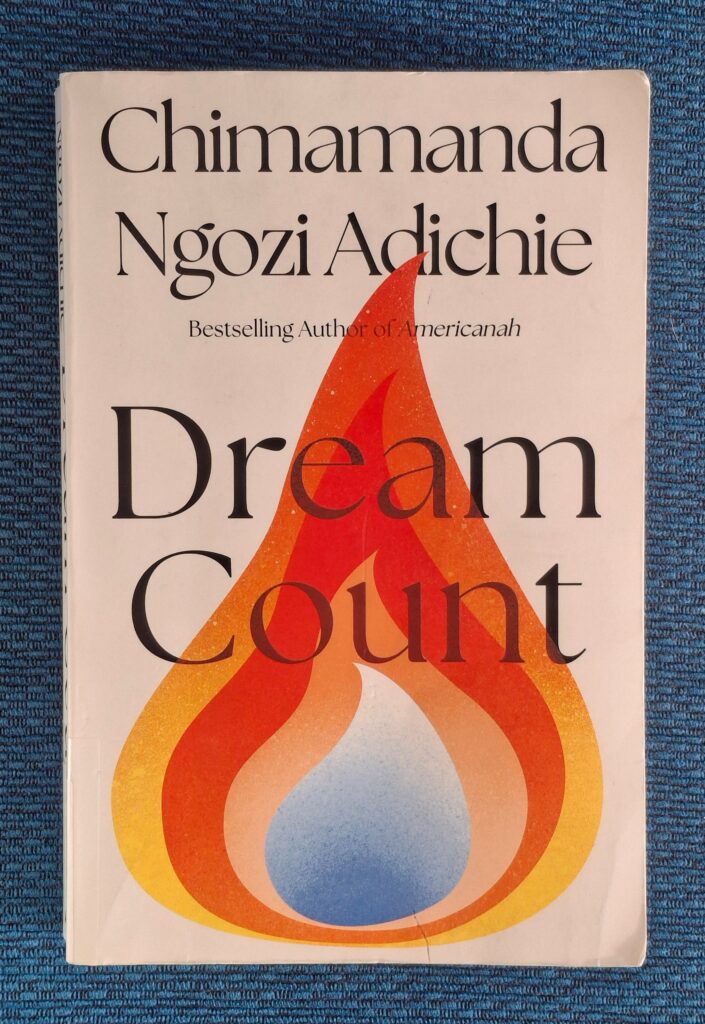
This book is about the life and (mostly failed) loves of three women: Chia, her friend Zikora and her cousin Omelogor. They are all Nigerian, living variously in the USA and Nigeria, quite well-off, and each with their own interesting lives and stories. There is a fourth woman too, Kadiatou, an associate of Chia. She is also an African (albeit Guinean) living in the USA, but not at all well-off. Her role in the novel is quite different.
Each of these four women has a section of the novel devoted to her life story. The three main characters are all quite well-off and successful in their own way. I enjoyed reading all their histories and about West African culture and politics in general. I am pretty ignorant about that! I vaguely thought of Nigeria as a huge, populous, energetic country that would be richer if it were less corrupt. Perhaps that’s borne out by the characters’ stories in this book, even if they are not typical Nigerians. I enjoyed looking through this window into a world that is totally foreign to me.
There are some very nice descriptions of food and the culture surrounding it. One thing I took away from this book is the urge to cook jollof rice.
The salt in the stew (or jollof) is Kadiatou’s story. She suffers a traumatic event that reverberates for months. Kadiatou’s story is based very closely on a real case, which happened 15 years ago and made headlines around the world. It feels a bit inappropriate to write so closely about such a case, where the victim is still alive and is no doubt still suffering the aftereffects.
Still, in the novel it looks more and more as though her story will end badly. When it does come, near the end of the novel, the resolution somehow ends up being both plausible and satisfying even though it didn’t go the way I hoped it would. It provided a good conclusion to this lively and insightful novel.