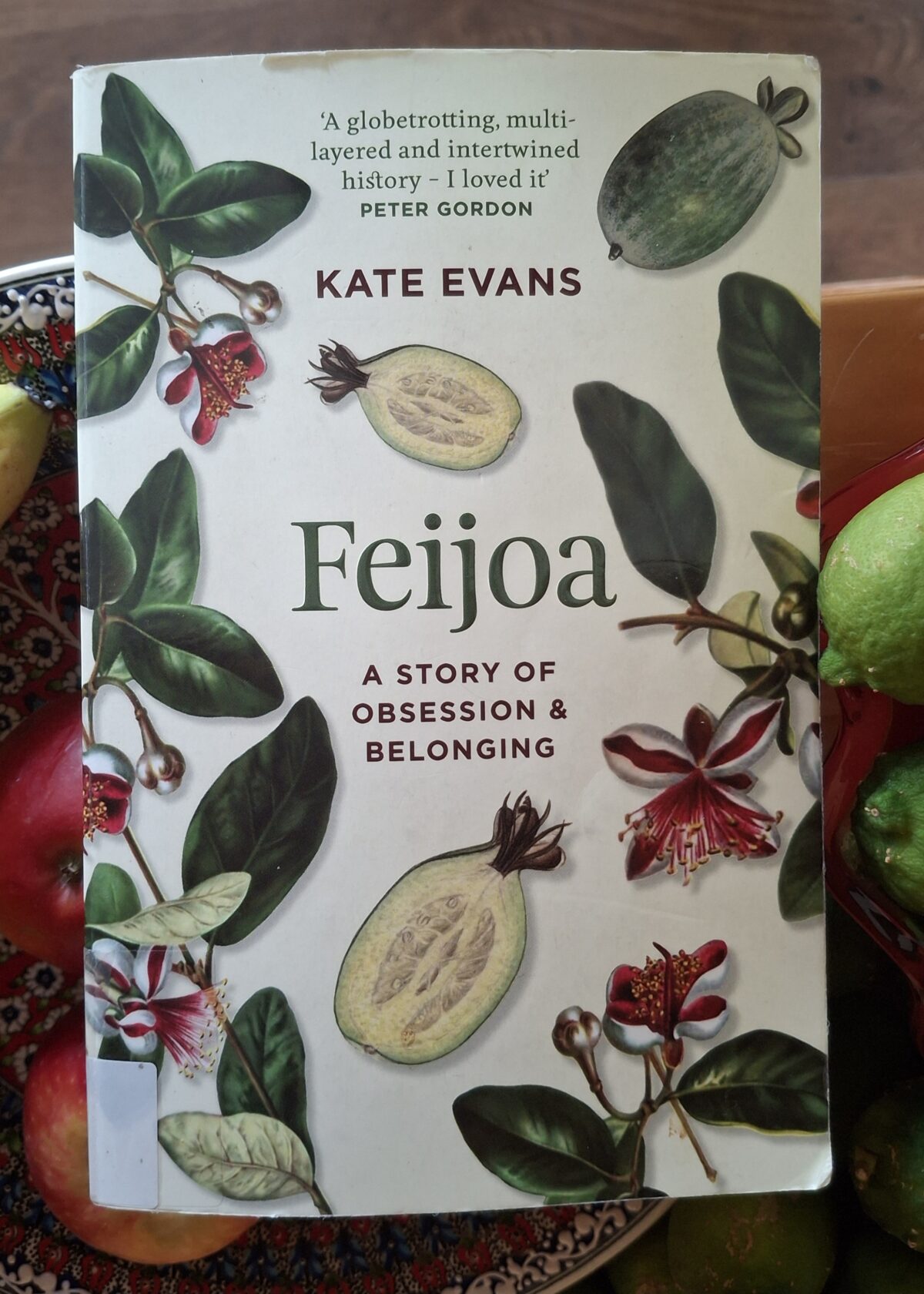
This is not the story of the feijoa. It is the story of Kate Evans’s journey investigating the story of the feijoa. Along the way we do learn a lot of interesting stuff about feijoas, but we also learn a lot about Evans’s life, her love of feijoas, her experiences travelling the world in search of feijoa lore, the people she met along the way and their stories, and how she came to write this book.
Feijoas have a unique and evocative flavour. When I eat one, it takes me back to times spent sitting under a feijoa tree with a spoon, picking up and eating fallen feijoas. Evans talks about this very memory, which must be common to many New Zealanders. And you can’t talk about tastes evoking childhood memories without talking about Proust and the madeleine, which she dutifully does. Any discussion of Proust gets a nod of approval from me.
Apart from simple memories of kids eating feijoas, Evans explores more generally the position of the feijoa in the New Zealand national psyche. It’s probably hard to understand this if you’re not a kiwi, but she lays it out pretty well. I grew up with feijoas as a kid. (I don’t think we had a tree, but our neighbour had several and shared the fruit with us, as is the kiwi way.) And my house now used to have two trees, but one fell over in a storm and the other was overrun with pests, so I am a bit sad about that.
The feijoa came to NZ only last century, from South America. As an introduced species, there is ample room for metaphors about colonialism and belonging, which Evans discusses at length too. But there is a nice twist at the end when she reveals there is an argument that the feijoa did, in a sense, originate in NZ after all. No spoilers – you’ll have to read the book for the details.